SME Challenge
SME Goes Digital Challenge
Introducing Digital Transformation
- Digital technologies transform modern life
- Changing how we work, play, relate, and learn COVID-19 highlighting indispensability of digital technology
- Maintaining continuity in various sectors, including higher education
- Digital technologies as a stabilizing force in the face of disruption
- Antecedent constructs: digitization, digitalization, digital transformation
- Essential to understand differences and relationships between these concepts
DIVIDE & CONQUER
In the pre-digital economy we architected for efficiency
EMPOWER & PARTNER
In the digital economy we architect for agility
How do we design to empower and partner?
There is fairly clear agreement on the definition of ‘technology’.
At a basic level ‘technology’ is understood as the process by which humans modify nature to meet their needs and wants. In a (pre)historic sense, the concept of technology therefore refers to humans’ ongoing use of tools and crafts to adapt and
control their environment.
As Volti (1992, p. 4) puts it, ‘technologies are developed and applied so that we can do things not otherwise possible, or so that we can do them cheaper, faster and easier’.
It is important to recognize that technologies do not always change things for the
better.
Technologies do not always allow people to work more efficiently, or support people in doing what they want (or need).
Instead, healthcare technologies can often have unexpected and unintended consequences. Technologies are often linked to a range of other issues far beyond immediate concerns of the individual patient, practitioner or hospital ward.
– Digital technologies transforming modern life
– Antecedent constructs:
- Digitization
- Digitalization
- Digital transformation
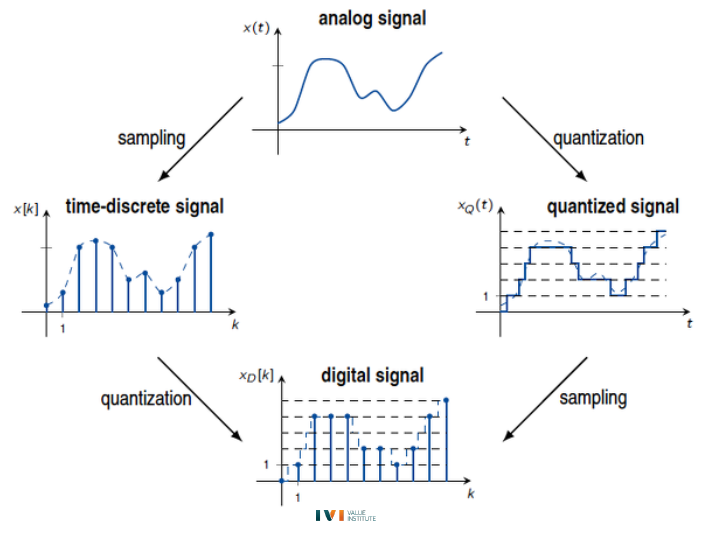
Conversion of analogue information to digital binary form
Examples: scanning paper documents, digitizing historical records, converting audio/video recordings
Benefits: improved storage, accessibility, preservation, reduced physical space, advanced data processing
Challenges: cost/time, quality accuracy, digital preservation, compatibility, metadata management
We need to now define what ‘the digital’ is and consider what wider practices,
contexts, issues and factors it may be linked to.
The ‘digital’ aspects of contemporary life are now so frequently talked about that it is easy to overlook the origins of the term.
At a basic level of description ‘digital’ simply refers to discontinuous data, based on the two distinct states of ‘on’ or ‘off’ (or 1 and 0) with no value in-between.
Digital computers, for example, are only capable of distinguishing between these two values of 0 and 1, but are able to use binary codes to combine these zeros and ones into large numbers and other practical forms of information.
In order to understand the significance of digital data it is important to also understand its opposite – analogue data.
‘Analogue’ refers to data that can be measured as a continuously varying
value.
The most commonly cited example of analogue data is the hands of a clock that by moving continuously around the clock-face provide an ongoing measurement of time. A digital clock, in comparison, is only capable of presenting a discontinuous series of numbers denoting time with a gap between each value (every one hundredth of a second, for example).
This distinction between digital and analogue may appear to be a subtle technicality, but it is crucial in understanding why digital technologies play such an important role in how we engage with transformation.
In particular, it is important to remember that humans generally experience the real world in analogue form.
For example, vision is a response to the everchanging intensity and wavelengths of light. Similarly, sound is made when objects vibrate producing continually fluctuating pressure waves that can be picked up by our ears.
Nevertheless, as the examples of the digital clock and waveform suggest, most analogue events can be simulated through digital information.
So why then do contemporary technologies privilege digital information over analogue?
- Digital information is far easier to store and distribute electronically as it is dense and compressible, meaning that a lot of digital data can be stored on a small physical space.
- Digital data are easier to manipulate accurately than ‘real-world’ analogue data. A good comparison of the
manipulability of analogue and digital information would be the lengths that you would have to go to alter the appearance of a conventional photo- graph as opposed to a digital image on screen. - Digital data are seen to give the user more control over using, storing and altering data as they see fit.
- It is much cheaper to distribute and sell large amounts of digital data. Digital technologies make good
technological and good commercial sense.
One of the striking characteristics of many recent accounts and analyses of the digital age is the generally transformatory and often optimistic ways in which the changes associated with digital technology tend to be imagined.
In short, most accounts of the digital age are framed within discourses of progress, transformation and the allure of ‘the new and improved’.
Digitally based activities are seen to borrow from, refashion and often surpass their earlier pre-digital equivalents.
For many commentators the obvious answer to overcoming contemporary social problems (e.g. in healthcare, education, social media) is now believed to involve some form of digitally related solution. As Steve Woolgar reflects, ‘the implication is that something new, different, and (usually) better is happening’ (2002, p. 3).
Perhaps the most prominent digital technology of the past 20 years is internet-based technologies.
A defining characteristic of most digital technologies is that they draw upon ‘networking’ logic. This is apparent in the technologies we relied upon to connect people, objects, organisations and information regardless of space, place, or time during the pandemic.
One further characteristic of technologies is their ‘convergence’ – the tendency for different technologies to perform similar tasks, share resources and interlink with each other. This ever-increasing capacity for storage and connectivity means that the builtin capabilities of technologies is becoming less important than their ability to connect to more powerful machines elsewhere. This is often described as ‘cloud computing’.
As Charles Leadbeater concludes, cloud computing ‘allows us to connect through a dense cloud of information’ (2010, p. 21).
It could appear to you that this talk has little direct relevance to the key issues, concerns and debates that you might consider to lie at the heart of digital technology.
I have talked much of technology (and a little of digital). There has deliberately been very little discussion of the two concepts in union.
Instead, our discussion so far has taken the necessary step of what Neil Selwyn describes as ‘disengaging ourselves from own our personal experiences of the digital age and thinking dispassionately about the role of technology in society’.
Often social scientists refer to this process as ‘making the familiar strange’ – an awkward but necessary initial stage of any learning process.
This talk has therefore attempted to take a step back from the day-to-day details of technology use and develop a solid basis for re-evaluating and re-approaching the topic.

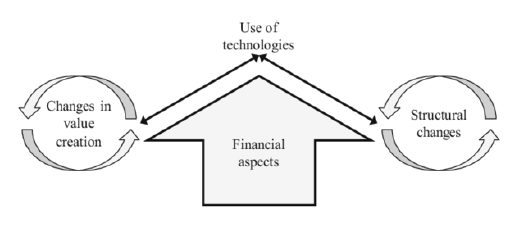
Use of digital technologies to change organizational operations
Examples: digital supply chain management, CRM systems, digital platforms for collaboration
Benefits: improved efficiency, enhanced data capabilities, increased flexibility, reduced costs/errors, new collaboration forms
Challenges: resistance to change, integration issues, data privacy/security, skill development, cultural change
Organizational change driven by digital technologies
Examples: new digital products/services, redesigning customer experiences, leveraging data analytics/AI
Benefits: adaptability, improved customer experience, enhanced competitiveness, operational efficiency, new revenue streams
Challenges: significant investment, overcoming silos, aligning initiatives with mission, managing risk/cybersecurity, agile governance
- Digitization as a foundation
- Digitalization as an enabler of transformation
- Digital transformation as a holistic and strategic approach
- Important to understand the distinctions and relationships
- CX
- Globalization
- Marketization
- Commodification
- Convergence
- Catalyst Events
- Social Capital
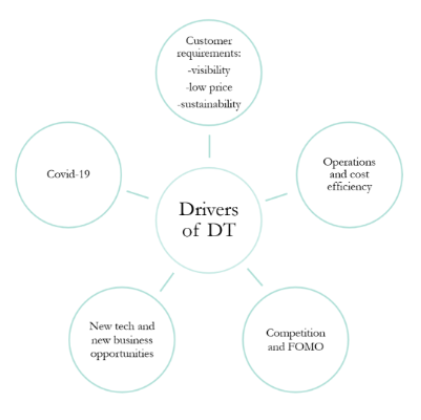
- Technological advancements
- Changing customer expectations
- Competitive pressures
- Operational efficiency
- Cost reduction
- Regulatory and compliance requirements
- Sustainability
- External ecosystem
- Cultural
- Leadership and vision
- Digital culture and mindset
- Digital skills and capabilities
- Data and analytics
- Technology infrastructure and architecture
- Spillover
The umbrella term of ‘digital technology’ can refer to a range of different aspects of contemporary technology use requiring computer-based systems – particularly software applications and computer hardware – that can be used to produce, manipulate, store, communicate and disseminate information.
The Digital Maturity Matrix provides a framework for assessing an organization’s digital maturity across two key dimensions:
- Digital Capabilities:
- This dimension evaluates the organization’s digital capabilities in areas such as customer experience,
operational processes, business models, and digital talent. - Organizations can range from “Beginners” who are just starting to build digital capabilities, to “Fashionistas” who invest heavily but lack integration, to “Conservatives” who lag behind, to “Digirati” who have deeply embedded digital capabilities.
- Leadership and Governance:
- This dimension assesses the organization’s digital leadership and governance, including the vision, engagement of top management, and the alignment of digital initiatives with the overall business strategy.
- Organizations can range from “Beginners” with an ad-hoc approach, to “Conservatives” with low digital leadership, to “Fashionistas” with strong digital leadership but lacking integration, to “Digirati” who have strong digital leadership deeply embedded across the organization.
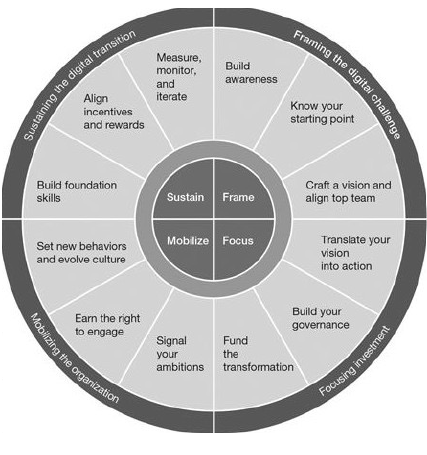
By plotting an organization’s position on the two dimensions, the Digital Maturity Matrix provides insights into the organization’s overall digital maturity and suggests areas for improvement. The goal is for organizations to progress towards becoming “Digirati” – those that have both strong digital capabilities and strong digital leadership and governance.
The matrix helps organizations understand their current state, identify gaps, and develop a roadmap to advance their digital maturity and transformation efforts.
1. Assess current digital maturity and readiness
2. Define digital vision and strategy
3. Establish digital governance and leadership
4. Develop digital capabilities and skills
5. Implement digital initiatives and projects
6. Measure and optimize digital performance
• Resistance to change
• Legacy systems and technical debt
• Cybersecurity and data privacy
• Skill gaps and talent shortages
• Siloed organizational structures
• Others?
“Every system is perfectly designed to get the results it gets. If we want better outcomes, we must change something in the system. To do this we need to understand our systems.”
Don Berwick, President and CEO, Institute for Healthcare Improvement (IHI);
former Administrator of the Centers for Medicare and Medicaid Services, USA
Code/Space (Dodge and Kitchin, 2014) is a concept that maps the interconnectedness of physical spaces and the technology they rely on to function.
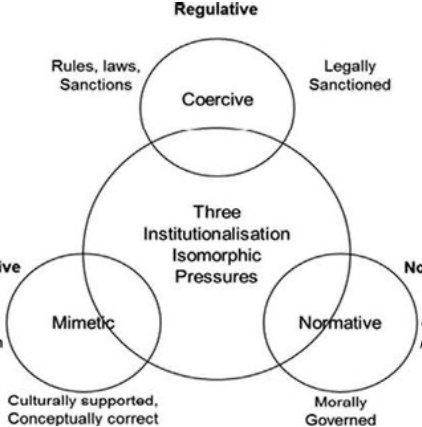
Institutional isomorphism explains the homogeneity of organisations in a field (DiMaggio and Powell, 1983).
Information systems (IS) drive isomorphism in organizations. The IS impact affecting isomorphism is greater when the dependence of the organisation on information technology is greater, which increases the risk of undertaking institutional change.
“Paradoxically, risk aversion is becoming ever more risky. In a very unstable world, your desire to avoid change does not mean that change will avoid you. We are in an era, not just for Ireland but for humanity, in which radical transformation is the only safe path. Continuity is danger. More of the same is the recipe for disaster. And at a more parochial level, we know
that …continuity has been failing to produce the goods.”
The Irish Times. (2020). Fintan O’Toole: Safety-first politics has had its day. [online]
Available at: https://www.irishtimes.com/opinion/fintan-o-toole-safety-first-politics-has-had-its-day-1.4145605
[Accessed 21 Jan. 2020]
Digital Transformation signifies a fundamental change in how technology, people, and processes combine to radically enhance organizations.
This digital transformation imperative requires organisations to improve – and often completely overhaul – their technical capabilities.
Now more than ever, there is intense pressure on organisations to transform their enterprises to remain high-performing in an age of disruption.
But true transformation demands more than just new technologies. It requires strategic vision and commitment from the top of the organization to rethink and retool the three main attributes of the modern organisation:
- its culture
- its processes
- and its technology
Any effective digital business leader will tell you that introducing new technology is the easier part; it’s the cultural and process changes that can thwart transformation progress.
- Customer-centric approach
- Data-driven decision-making
- Agile and iterative development
- Ecosystem collaboration and partnerships
- Success stories and case studies
- LLMs, AI, and Machine Learning
- IoT and Edge Computing
- Blockchain and Distributed Ledger Technology (DLT)
- AR and VR
- Quantum Computing and Cryptography
- Future of Work and Digital Skills
- Digital Divide and Inclusion
- Algorithmic Bias and Fairness
- Privacy and Data Protection
- Job Displacement and Reskilling
- Digital Wellbeing and Screen Time
- Digital Transformation KPIs
- Digital Maturity and Readiness Assessments
- Return on Digital Investment (RODI)
- Stakeholder Feedback and Satisfaction
- Benchmarking and Competitive Analysis
- Digital Transformation Steering Committee
- Chief Digital Officer (CDO) and
- Digital Leadership Roles
- Digital Talent Management and Skill Development
- Digital Innovation and Experimentation Culture
- Digital Ethics and Responsible Leadership
- Digital Platform and Ecosystem Strategy
- Strategic Partnerships and Alliances
- Open Innovation and
- Crowdsourcing
- Digital Supply Chain and Network Optimization
- Digital Ecosystem Governance and Orchestration
- Digital Workflow Automation and Optimization
- ERP and Integrated Systems
- Digital Procurement and Supply Chain Management
- Digital Marketing
- Cybersecurity and Data Governance
- Digital transformation is a complex, ongoing process
- All organisations face unique challenges and opportunities
- Requires technological, organizational, and cultural factors
- Necessitates strong leadership, governance, and partnerships
- Measurement and evaluation are critical (but not ‘managing to the measure’)
- Ethical and social considerations are essential
- Organisations that embrace digital transformation will be better positioned for success
Empathise The Human Experience of Digital Transformation
“The pursuit of profit is core to capitalism. Profit, in turn, is generated through entrepreneurship and innovation. The value created in the economic system is shared between society and the various stakeholders (including shareholders and employees) of business firms that produce or adopt innovations. While it is self-evident to most observers that some firms are far better than others at innovating and generating profits, economic theory has surprisingly little to say about why this might be so.
The black-box model of the firm common to many economic models creates a blind spot that distorts […] analyses.”
– Teece, D. 2019, p. 1
Our challenge today is to ‘open the black box’!
- Culture (People)
- Process
- Technology
All three must be aligned for successful, sustainable improvement
- Technology has no inherent value
- Benefits arise when IT enables to do things differently
- Only the Business – that is, all of an organisation’s and individual contributors can release the potential business benefits and business value technology
- All IT projects have outcomes, but not all outcomes are benefits
- Benefits must be actively managed for value to be obtained
Empathy:
When you can feel what the other person is feeling and can mirror their expression, their opinions, and their hopes
Define:
Defining the problem is a concise, unique reframing of the problem that is grounded in people’s needs and insights.
Ideate:
Generating as many solutions as possible to a problem.
Prototype:
Create a concrete embodiment of a concept which becomes a way to test your hypothesis to get closer to your solution.
Test:
Try out you concept with people using your prototype
Most problems are too complex for one person to solve.
Multiple perspectives, skills, disciplines, experiences, knowledge and sharing practices is key.
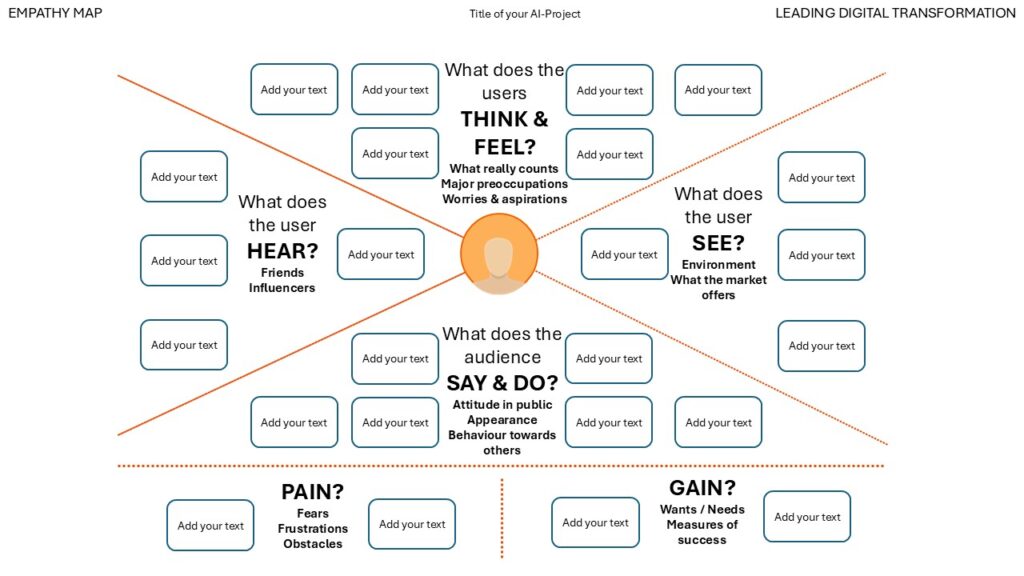
- Example: Digital Transformation in SME Food & Beverage
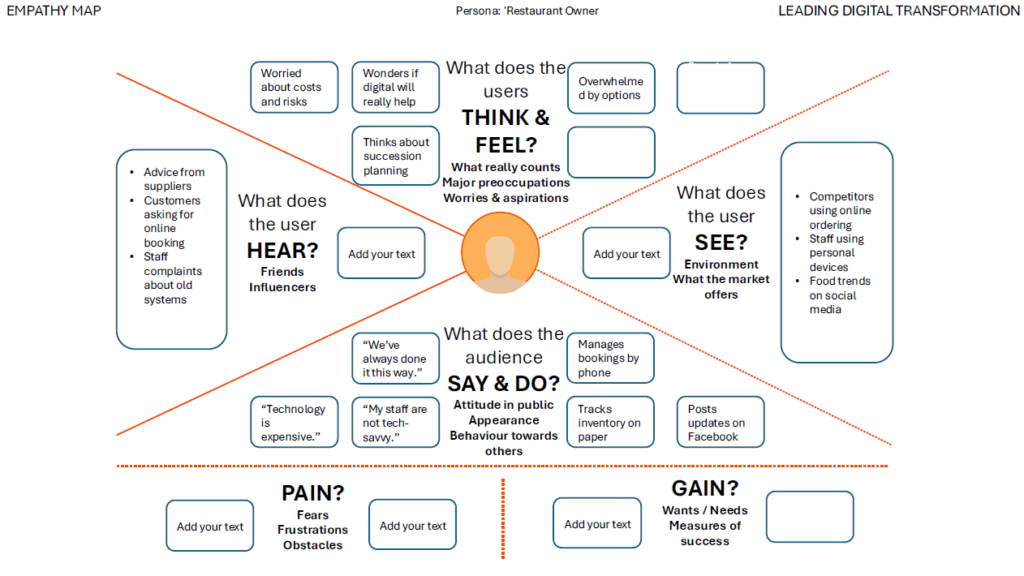
- Empathy maps help teams understand the needs, experiences, and pain points of people affected by change.
- Here’s how you can use one when working with small to medium food & beverage businesses.
- Visual tool for understanding a person’s experience.
- Centres on a persona: e.g., a typical SME food & beverage business owner.
- Explores their environment, thoughts, actions, and feelings.
- Encourages teams to design solutions with empathy.
- At the start of a digital transformation project.
- After conducting interviews or surveys with SME stakeholders.
- When aligning your team on user needs and pain points.
- Place the persona at the center. Surround them with these key sections:
- Sees: What do they observe?
- Says: What do they say about digital tools or challenges?
- Hears: What do they hear from others?
- Does: What are their actions?
- Thinks: What do they worry or dream about?
Does:
- Manages bookings by phone
- Tracks inventory on paper
- Posts updates on Facebook
Feels:
- Overwhelmed by options
- Anxious about change
- Proud of their business
Thinks:
- Worried about costs and risks
- Wonders if digital will really help
- Thinks about succession planning
- Define your persona: e.g., ‘Owner of a 40-seat restaurant.’
- Gather insights from interviews, surveys, and observations.
- Work as a team: Fill out each section with real quotes, behaviors, and feelings.
- Identify patterns: Note repeated pain points, hopes, or obstacles.
- Use findings to shape your digital solutions and communication.
- Address real concerns: E.g., offer affordable, easy-to-use digital tools.
- Leverage what they hear: Use testimonials from similar businesses.
- Support and training: Help staff gain confidence with new tech.
- Celebrate small wins: Highlight successes to reduce anxiety.
- Empathy maps help you see through your customer’s eyes.
- They reveal opportunities for better engagement and smoother transformation.
- Use them to build solutions people want and need—not just what’s possible.
Over to you: Ready to map your SME Challenge journey?
Define the Problem to be Solved
- Recall Apollo 13: disaster in space, Mission Control’s intense focus.
- In the movie, Gene Kranz draws a simple chalk map: spaceship’s path home.
- The map is their anchor—through chaos, it keeps everyone on the right problem.
- Lesson: When tackling big challenges, resist the urge to jump to solutions. Start by defining what success *really* means.
- When faced with a big problem, it’s natural to rush to fixing what’s most visible.
- But if you don’t slow down and set priorities, you risk missing your window—just like if Mission Control had fixed the air filter before correcting the trajectory.
- Sprint Principle:Small iterative steps to make greater progress
- Imagine you’re at the end of the sprint, or a year from now.
- What questions would you want answered?
- What would “success” really look like for your business, team, or users?
- Even if the future seems obvious, make it specific and write it down.
- Ask the team: “If we could fast-forward, what would have improved?”
- Ask: “Why are we doing this project?”
- Where do we want to be in 6 months, 1 year, 5 years?
- Write the long-term goal at the top of the whiteboard.
- Example: Blue Bottle Coffee’s goal wasn’t just “sell more coffee,” but “bring great coffee to new customers online, without sacrificing quality.”
- The goal should reflect your aspirations and principles—it’s your north star for the week.
- Facilitator Tip: If the team doesn’t immediately agree, discuss until there’s clarity.
- Shift from optimism (goal-setting) to pessimism: What could go wrong?
- Imagine the project failed. Why?
- What has to be true to succeed?
- Turn assumptions into questions:
- “Will users trust our expertise?”
- “Will clinics change their workflow?”
- “Can we find matches fast enough?”
- Write these next to the long-term goal.
- Facilitator Tip: Reframe as “What do we want to learn this week?” or “What scares us most?”
- Like Tolkien’s map for The Lord of the Rings, your map will make sense of complexity.
- How to map:
- List actors (main characters) on the left—users, staff, etc.
- Write the ending (goal state) on the right.
- Fill in the major steps in between, using arrows and boxes.
- Keep it simple: 5–15 steps.
- The map is a customer-centric story from start to finish.
- Review the map with the team.
- Is anything missing? Are the steps clear?
- Don’t get bogged down in details—focus on the big story.
- The map is a living artifact: update it as new information emerges.
- Knowledge is distributed—no one person knows everything.
- Conduct a series of short interviews:
- The Decider (strategy)
- “Voice of the customer” (sales, support, research)
- Technical experts (how things work)
- People with experience in previous efforts
- Use the map as a guide for discussion.
- Take “How Might We…” notes—turn problems into opportunities.
- Ask: “What are we missing?”, “Where do things break down?”, “What’s misunderstood?”
- Everyone writes “How Might We…” notes on sticky notes during expert interviews.
- At the end, stick them all on the wall—messy at first.
- Group notes by theme; label clusters.
- Vote (dot voting) for the most important opportunities.
- Attach top-voted notes to relevant steps on the map.
- Don’t overthink the groupings—move fast, and let the most promising ideas rise.
- Review: long-term goal, sprint questions, map, and top “How Might We” notes.
- Ask: Which step/actor is riskiest? Which opportunity is most critical and solvable in one week?
- The team, with a straw poll chooses one target—a customer and a moment on the map.
- This becomes the focus for the rest of the sprint: all sketches, prototypes, and tests centre on this target.
Ideate: Case Study Activities
- No group brainstorming, no shouting or wild idea games.
- Instead: individual sketching – the Design Sprint way to generate solutions.
- Most people feel uneasy about drawing—especially in groups.
- Good news: anyone can sketch a great solution!
- You don’t need to be an artist. Boxes, words, and stick figures are all you need.
- It’s about ideas, not artistry.
- Abstract ideas get lost in conversation—sketches make them concrete.
- Sketching is the fastest way to turn thoughts into shareable, testable solutions.
- When ideas are visual, everyone can understand and fairly evaluate them—no sales pitch required.
- Group brainstorming often leads to groupthink or loudest-voice-wins.
- In a sprint, you work alone, in parallel—everyone develops ideas deeply and independently.
- This “work alone together” method produces more creative, well-developed solutions.
- Notes (20 min):
–Walk around, review the long-term goal, map, “How Might We” notes, and any Lightning Demos.
–Take personal notes—these are your memory refreshers and inspiration.
- Ideas (20 min):
–Doodle, write headlines, draw diagrams—generate rough, messy ideas.
–These are for your eyes only.
- Crazy 8s (8 min):
–Fold a sheet of paper into 8 panels.
–Sketch 8 variations of your favorite idea—1 minute per sketch!
–Crazy 8s forces you to go beyond your first idea and explore alternatives.
- Solution Sketch (30+ min):
–Choose your strongest concept and develop a detailed sketch.
–Make it clear, well-labeled, and easy to understand.
- Tell a story: Usually a 3-panel storyboard showing a user’s journey.
- Make it self-explanatory—no extra explanation needed.
- Keep it anonymous—no names, same paper and pens for all.
- “Ugly” is OK! Focus on clarity, not beauty.
- Words matter! Write real text, not “lorem ipsum.”
- Give it a catchy title to highlight the core idea.
- Use words, diagrams, stick figures—whatever makes your idea clear.
- Don’t worry about being neat, just be thoughtful and complete.
- If inspired, you can do more than one sketch, but one strong solution is enough.
- Thirty minutes is usually enough time.
- The “Mind Reader” sketch: a simple, box-and-text storyboard that became the foundation for a new website.
- Multiple sketches = more options for the team.
- Remember: the best sketches aren’t necessarily the prettiest, but the clearest.
- When everyone is done, collect all solution sketches in a pile.
- Don’t review or discuss yet—save your fresh eyes for critique and decision.
- Next: pick the strongest ideas to prototype!
Prototyping Techniques for Innovating Digital Solutions
- Prototyping is about building a realistic illusion, not a finished product.
- A prototype lets you test your ideas quickly and cheaply.
- The goal: Learn fast, invest little, and be ready to change.
- You Can Prototype Anything: Stay optimistic, there’s always a way to simulate your idea.
- Prototypes Are Disposable: Don’t get attached. Build to learn, not to launch.
- Build Just Enough to Learn: Focus on the key question, not on perfection.
- The Prototype Must Appear Real: If it looks real, you’ll get honest reactions—not just feedback.
- Too rough, people won’t believe it.
- Too polished, you’ll waste time and get attached.
- Find the “just right” level of realism for your product and your test.
- App: Simulate with slides, click-throughs, or video
- Website: Build interactive slides or use prototyping tools
- Paper Report: Print realistic mockups
- Physical Product: Use existing parts, mockups, or even marketing materials.
- Service/Space: Script an experience, modify an existing space, or role-play.
- For screens: Keynote, PowerPoint, Figma, InVision, Slides.
- For paper: Word, Keynote, Google Docs, printouts.
- For services: Scripts, actors, checklists, role-play.
- For spaces/objects: Modify what you have, use photos or props.
- Pro tip: Use the simplest tool that creates a convincing illusion.
- Makers: Build components (screens, pages, props).
- Stitcher: Assemble everything into a seamless experience.
- Writer: Craft all the real, believable text.
- Asset Collector: Find images, icons, videos, and materials.
- Interviewer: Prepares for Friday’s customer tests (writes interview script).
- Everyone has a part; teamwork is key to a quick build.
- Use the storyboard and solution sketches as your blueprint.
- Assign each scene or screen to a specific person or pair.
- Don’t skip the “opening scene”—set the stage for your testers.
- The Stitcher ensures all parts look and feel like one product or experience.
- Double-check for consistent names, details, and style.
- Fix typos, mismatches, and obvious “giveaways” that break the illusion.
- Gather the team for a full walk-through.
- Check against the storyboard: Did you build everything you need?
- The Interviewer should get familiar with the prototype and the key questions.
- Look for holes, breaks, or confusing parts—fix them before test day.
- Celebrate – you created a testable product!
- Stay unattached and open-minded: the goal is learning, not perfection.
- Next you’ll watch real users interact and react—get ready for insights.
- By completing both the online preparation and the in-person Module, you have developed the mindset and skills needed to act as a Responsible Dynamic Digital Change Agent in the Food & Beverage sector.
- You have experienced first-hand the value of working in multidisciplinary, multicultural teams, and learned how to co-create digital solutions that are both practical and impactful for SMEs.
- Through engaging directly with businesses, you will help to bridge the gap between academic learning and real-world application. In the process, you will gain valuable insights into the opportunities and challenges of digital transformation.
- The confidence, adaptability, and collaboration you have built will serve you not only in future studies and employment but also in shaping the future of sustainable, digitally enabled industries across Europe.
Pitch Event
The Pitch Event is the culmination of the SME Goes Digital Challenge. It provides student teams with the opportunity to showcase their solutions, demonstrate how they applied digital tools in the Food & Beverage sector, and convince a jury of experts and SME representatives of the value of their ideas.
- Present a clear problem statement: what issue does the SME face?
- Showcase the proposed digital solution and why it matters.
- Demonstrate the benefits for the SME (efficiency, cost savings, sustainability, competitiveness).
- Highlight team learning and interdisciplinary collaboration.
- Inspire the audience with creativity and feasibility.
- Introduction (30 sec) – Who you are, the SME partner, and the challenge context.
- The Problem (1 min) – Define the SME’s specific digitalisation challenge and why it matters.
- The Solution (2–3 min) – Present your digital solution. Use visuals, mockups, or demos to illustrate how it works.
- The Benefits (1–2 min) – Show how the solution helps the SME (quantify if possible: cost saved, waste reduced, efficiency improved).
- Next Steps (30 sec) – Outline what would be needed to implement the solution (resources, timeline, future development).
- Closing (15 sec) – Memorable ending: a quote, a call to action, or a vision of impact.
- Pitch Deck (Slides) – 5–7 slides max, focused on clarity and visuals.
- Demo/Prototype – Even a simple mockup or storyboard makes the solution more tangible.
- Executive Summary – 1–page written summary for the jury.
- Optional Video Demo – 2–3 min video showcasing how the solution works.
- Keep it simple and visual – avoid text-heavy slides.
- Tell a story – take the jury on a journey from problem to solution.
- Use data – even small indicators (e.g., “20% less food waste”) make your solution credible.
- Rehearse with timing – a 7-minute limit is strict, practice until the delivery is smooth.
- Assign roles – not everyone needs to speak, but those who do should be confident and clear.
- Organize a “Dry Run” session one week before the Pitch Event where each team presents and receives structured feedback.
- Provide a Pitch Template (slide deck structure) to ensure consistency across teams.
- Offer public speaking coaching: body language, voice control, handling Q&A.
- Remind teams to back up slides and demos in multiple formats to avoid technical issues.
- Relevance: Is the problem clearly defined and significant for the SME?
- Innovation: Is the solution creative and original?
- Feasibility: Could the solution realistically be implemented by the SME?
- Impact: What measurable benefits would the SME gain?
- Presentation: Was the pitch clear, engaging, and professional?
✨ By preparing carefully, student teams will not only deliver convincing pitches but also learn a critical real-world skill: how to present ideas persuasively to decision-makers in the business world.
RESOURCES
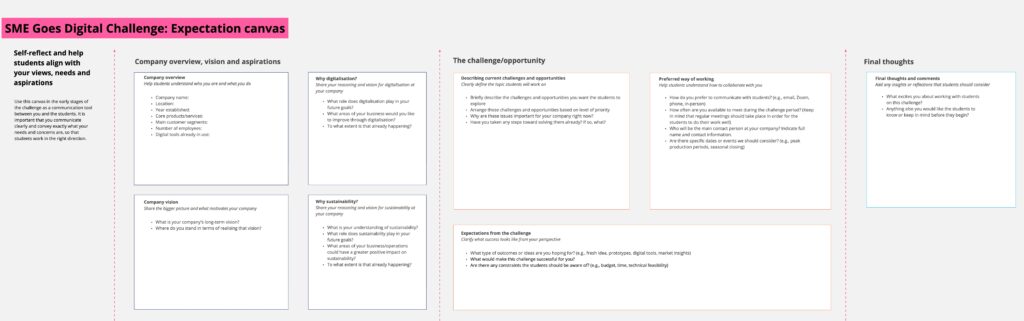
Open Educational Resources
Registration necessary in order to access OERs, track your certification progress, or access more resources.