
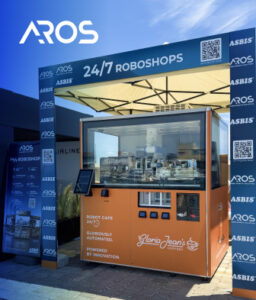
 Across Europe, autonomous robotic kiosks are becoming a practical alternative to traditional staffed retail. Cyprus has already begun experimenting with this trend. Two visible examples are the CandyBot at Larnaca International Airport and the new 24/7 RoboShops, such as the Robo Café showcased at the Limassol Boat Show 2025.
As DIGIFABS focuses on emerging technologies and digital transformation, these cases offer a real-world view of how robotics is reshaping customer service, business models, and operational efficiency. In this article, Maria Kyprianou, from DIGIFABS consortium partner ECECT considers the benefits and challenges these robotic retail systems present.
- CandyBot at Larnaca Airport: A simple but strategic deployment
The CandyBot at Larnaca Airport represents an early attempt at robotic retail in Cyprus. More than a vending machine, it is designed to attract travellers with its interactive lights, child-friendly movements, and a seamless purchasing process. Such “micro-automated retail points” fit well in airport environments where passengers expect convenience, staff coverage can be expensive, and 24/7 service is essential.
However, recent observations suggest that CandyBot is not always operational. This highlights a recurring challenge in robotic retail: these systems require consistent maintenance, real-time monitoring, and rapid technical support to remain functional and profitable.
- 24/7 RoboShops: A new wave of automated retail
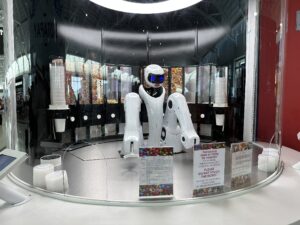 More advanced systems are now entering the Cypriot market, including 24/7 Robo Cafés and related RoboShop units such as the Robo Bar, Robo Drinks, and Robo Beer. These kiosks can prepare beverages automatically, process digital payments, and operate through remote monitoring platforms. Designed for high-traffic locations such as, airports, marinas, shopping malls, universities, events, they aim to deliver commercial-grade service without the need for on-site human staff. With capabilities of producing up to 700 servings per day, automated cleaning cycles, and predictive maintenance alerts, these units represent the next generation of autonomous service points.
AROS 24/7 ROBO CAFE in Marina, Limassol, Cyprus: www.asbis.com/24-7-robocafe
AROS 24/7 Robo Bar: https://www.youtube.com/watch?v=YEK10NPNi-s&t=21s
- Why businesses are interested: Operational and Economic advantages
Businesses are increasingly drawn to autonomous retail systems because they offer a blend of operational efficiency, cost reduction, and reliable service. On the technical side, robotic kiosks provide uninterrupted 24/7 availability without the need for staff scheduling, which is particularly valuable in tourism-driven environments.
Their integrated sensors monitor inventory levels, temperature conditions, and mechanical health, ensuring consistent performance and helping operators anticipate issues before they occur. These systems are supported by remote management platforms that allow owners to oversee sales, performance, stock usage, and maintenance needs from anywhere. As a result, product consistency is improved because each serving is prepared through programmed, standardised routines that eliminate human error.
Another advantage is their compact design, often requiring only one to two square meters, making them ideal for micro-locations that cannot support full retail outlets.
From a business perspective, the financial benefits are just as compelling. Labour costs are significantly reduced, particularly in sectors that struggle with staffing shortages. Many vendors report predictable returns on investment, often within 12 to 18 months when units are placed in high-footfall areas.
Their novelty and visual appeal help attract customer attention, generating additional impulse purchases and improving revenue potential. Because these systems can be deployed in multiple locations and managed remotely by a single team, businesses can scale operations quickly and efficiently. Furthermore, the data collected by these units, such as sales patterns, peak usage times, and product preferences, supports smarter decision-making in pricing, stock selection, and location planning. For industries like hospitality and tourism, where labour shortages are ongoing, autonomous kiosks present a sustainable solution that maintains service quality without increasing staff requirements.
- Challenges and considerations: What companies must evaluate first
Despite their advantages, robotic retail systems also present several challenges that companies must carefully evaluate before investing. From a technical perspective, these units depend heavily on regular maintenance, and any downtime directly affects revenue and customer trust. Robots especially those handling food and beverages require daily cleaning cycles to comply with hygiene regulations, meaning that some human intervention remains necessary. Software reliability is another critical issue; network interruptions or payment system failures can halt operations entirely. Additionally, outdoor deployments must account for environmental factors such as humidity, dust, heat, or rain, all of which can impact machine performance and longevity.
Financial and regulatory considerations are equally important. The initial investment for deploying such systems can range from €20,000 to over €80,000, depending on the complexity of the model, embedded sensors, and payment integrations. Achieving a strong return on investment is only realistic if the unit is placed in a location with consistent, high-level foot traffic. Businesses must also comply with strict food safety regulations, particularly when units handle fresh ingredients like milk, syrups, or filtered water.
Customer acceptance plays a role too, while many people enjoy the novelty of robots, others may hesitate to purchase from them, meaning that engagement and trust-building remain essential. Finally, companies must ensure that the robot’s output meets their brand standards so that the automated service maintains the same level of quality customers expect from human-operated points.
Before adopting any robotic solution, SMEs should reflect on whether this technology aligns with their operational needs, customer profile, and long-term sustainability strategy.
- DIGIFABS perspective: Lessons for sustainable adoption
From a digital capacity-building perspective, the rise of robotic retail underscores the need for business-readiness frameworks that help SMEs evaluate costs, regulations, maintenance responsibilities, and long-term viability. It also highlights emerging skills gaps, particularly in remote monitoring, IoT diagnostics, and robotic servicing areas where training programmes like DIGIFABS can provide valuable support. There is also potential for developing certification schemes, such as “Operational Standards for Automated Retail Units,” to ensure quality and consistency. Importantly, sustainability must remain a priority so that robots remain online, profitable, safe, and compliant, not just impressive during launch events.
Conclusion
Robotic retail is evolving rapidly, and Cyprus is already participating in this shift. Whether dispensing candy or serving a cappuccino, autonomous kiosks offer a glimpse into the future of customer service. They deliver convenience, consistency, and efficiency, but only when supported by the right planning, location selection, and maintenance strategy. For DIGIFABS, these examples highlight the importance of preparing businesses and their workforce for the sustainable and responsible adoption of robotics across Europe.