
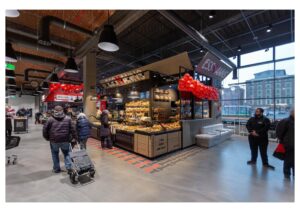
 As part of the DIGIFABS Challenge Essmann’s Backstube GmbH is participating in a student-led applied project. The family-owned bakery business, headquartered in the Münster region (North Rhine-Westphalia, Germany) and operating more than 60 locations, is working together with students from FH Münster University of Applied Sciences on a data-driven location analysis.
The aim of the project is to systematically evaluate key factors such as demographic data, purchasing power, pedestrian and traffic flows, competitive density, and anchor locations, and to integrate them into a structured decision-making model for potential future store locations. In doing so, international project approaches and academic methods are directly applied to the strategic development of a regionally rooted company.
In the following short interview, Julian Feller, Head of Marketing at Essmann’s Backstube GmbH, explains why the company decided to take part in the project.
Why did you decide to participate in the project?
We deliberately chose to take part in this student project because the exchange between academia and business practice is very important to us. As a medium-sized company with a strong regional focus, we regularly face strategic questions that can be analysed very well using data-driven and analytical approaches. The project allows us to gain new perspectives, test innovative ideas, and at the same time give young talents real insights into entrepreneurial decision-making processes.
What is the focus of the student project?
At the core of the project is the development of a data-driven location analysis for potential future store locations. The goal is to systematically analyse various influencing factors such as pedestrian and traffic flows, demographic data, purchasing power, competitive density, and anchor points, and to combine them into a scoring model. The results are visualised in an interactive heatmap, which can serve as a strategic decision-support tool.
What outcomes do you hope to gain from the collaboration?
From the collaboration, we primarily expect well-founded and structured decision-making foundations for early-stage location assessment. Transparent evaluation logic, reproducible results, and a tool that can be used as a pre-screening instrument for potential expansions are particularly valuable to us. In addition, we expect impulses for the further development of our data-driven way of working and a critical reflection of existing assumptions through an external academic perspective.