
Digital Responses: Start from the Problem

  • Do not start with the tool. Start with the business problem, available data and implementation capacity.
  • AI/ML can support prediction, process optimisation, demand planning or waste reduction.
  • Blockchain can support traceability, transparency, recall management and trust between supply-chain actors.
  • For each SME case, ask: What problem are we solving, for whom, with what data and at what cost?

MOOC checkpoint: Choose one SME challenge and identify the smallest digital step that could be tested first.

Blockchain for Supply Chain Disruptions and Economic Pressures
Blockchain technology enhances supply chain resilience by providing:​
  • End-to-End Traceability: Blockchain offers real-time visibility into the movement of goods, enabling swift identification of bottlenecks and disruptions. ​
  • Immutable Records: The decentralized ledger ensures that all transactions are securely recorded, reducing disputes and enhancing trust among stakeholders. ​
  • Smart Contracts: Automated agreements facilitate timely payments and compliance, streamlining operations and reducing administrative overhead. ​
CHALLENGE 2: SUSTAINABILITY AND CLIMATE CHANGE
  • The food and beverage industry is a significant contributor to greenhouse gas emissions, especially through livestock production, which generates substantial amounts of methane.
  • At the same time, the sector is highly vulnerable to the impacts of climate change, such as extreme weather events that affect agricultural production and supply stability.​
  • Consumers are increasingly demanding sustainable products with lower environmental footprints, prompting businesses to reconsider their production and distribution processes.
  • However, implementing sustainable practices often requires significant investments and changes to existing business models.
Blockchain for Sustainability and Climate Change in F&B
Blockchain supports sustainability initiatives through:​
  • Transparent Sustainability Claims: By recording certifications and sourcing information, blockchain enables verification of sustainable practices, fostering consumer trust. ​
  • Carbon Footprint Tracking: Integration with IoT devices allows for monitoring of emissions and resource usage, aiding in environmental impact assessments. ​
  • Waste Reduction: Enhanced traceability helps in identifying inefficiencies and reducing food waste across the supply chain.
CHALLENGE 3: REGULATORY COMPLEXITY AND CONSUMER EXPECTATIONS
  • The regulatory environment in the food and beverage sector is continually evolving.
  • New requirements are being introduced for food traceability, allergen labelling, and packaging material restrictions.
  • These changes demand flexibility from businesses and the ability to quickly adapt to new standards.​
  • At the same time, consumers expect greater transparency, safety, and personalization of products.
  • This pressure increases the need to implement digital technologies, such as AI and blockchain, which can help ensure the credibility and traceability of products.
Blockchain for Regulatory Compliance and Meeting Consumer Expectations in F&B
Blockchain addresses regulatory and consumer demands
  • Compliance Facilitation: Automated data recording simplifies adherence to food safety standards and regulatory requirements. ​

  • Consumer Transparency: Providing access to product histories enhances consumer confidence and meets the demand for information on product origins and handling. ​

  • Efficient Recall Management: In case of contamination, blockchain enables rapid identification and removal of affected products, minimizing health risks.

What Are the Risks of Going Digital? A Reality Check for SMEs
  • While AI, ML, and blockchain bring major opportunities, their implementation in SMEs is not without challenges.
  • Addressing these barriers is essential for meaningful digital transformation.

Lack of digital skills

Many F&B SMEs lack internal expertise in data analytics, AI, or cybersecurity. This limits long-term sustainability and creates dependency on external vendors

High upfront investment

Procuring AI or blockchain systems (hardware, software, training) can be expensive. The ROI is often unclear or delayed

Resistance to change

Digital tools may be seen as disruptive or unnecessary by staff used to manual processes. Cultural resistance can hinder success.

Data trust and security concerns

Businesses fear data breaches, AI decision opacity, or blockchain complexity, which can undermine confidence in the technologies
VIDEO PRESENTATION

Digital responses and barriers for F&B SMEs

RESOURCES

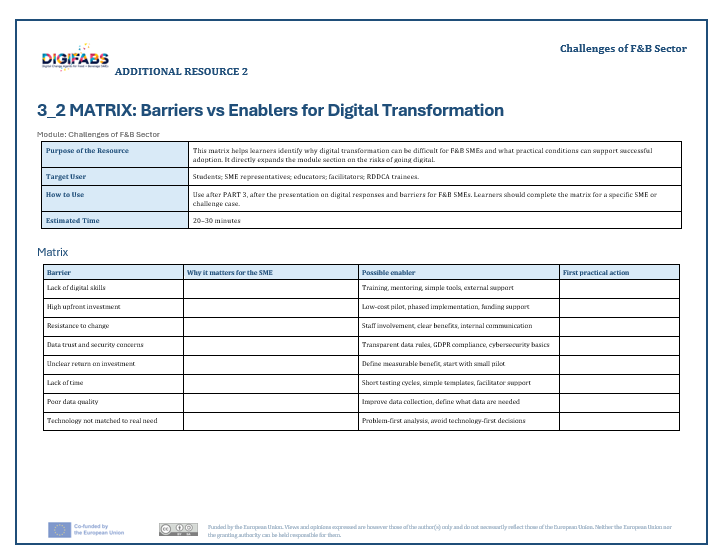
3_2 MATRIX

Barriers vs Enablers for Digital Transformation

PPT PRESENTATION

Digital responses and barriers for F&B SMEs