Bootcamp Concept
Introduction
The RDDCA Bootcamp will prepare educators and SMEs to successfully fulfil their roles as part of the ‘SME Goes Digital Challenge’, by providing them with a small international training, delivered online, to help them become familiar with the RDDCA concept, the latest trends in the F&B sector, as well as the basics of university-SME collaboration in order to ensure successful interaction during the challenge.
The bootcamps will prioritise flexibility and ease-to-engage and involve participants in a mix of discussions, seminars and interaction-based sessions to build capacity, both on the content and the personal sides, before the Challenge takes place.
- The objectives of the RDDCA Bootcamp are:
- Equip educators with the content and context needed for their role as facilitators of the Challenge, ensuring they can help their students navigate the complexities of challenge-based learning
- Help SMEs understand the context of the Challenge, acquiring insights on university-business engagement, effective communication and the potential that RDDCA could have for them
- Align the content and approach with the activities taking place as part of the Summer School work package
- Raise awareness among SMEs of the benefits of digitalisation and build a desire to participate in the Challenge
- Provide participants with opportunities to network and develop / explore potential collaborations, making everyone aware of how they could help each other out
The Bootcamp runs over 4 weeks. The duration of a standard training day will range from 1.5h to 2h, with some sessions not being mandatory for the participants.
Participants will engage in a mix of seminar-based sessions and workshops aimed at providing context on the F&B sector, the concept of RDDCA, emerging trends to be aware of, and at enabling collaboration through interactive sessions focused on networking and exchange of best practices. At the end of the Bootcamp, participants will engage in a workshop focused on university-SME cooperation and will work on preparing for their responsibilities as part of the Challenge (i.e., understanding the Facilitator Handbook and developing the Expectation canvas.
The DIGIFABS RDDCA Bootcamp follows a self-directed, challenge-based learning approach. Participants engage with short learning resources, practical examples, reflection prompts, and preparation tools that help them understand the RDDCA concept, identify relevant F&B digitalisation challenges, and prepare for effective university-SME collaboration.
Target Group
The DIGIFABS RDDCA Bootcamp is designed for educators and SMEs from the food and beverage sector, ensuring a wide range of perspectives and expertise, as well as challenges that will create the right environment for students to address SME’s issues with the help of educators.
Target Group
The RDDCA Bootcamp is aimed at preparing SMEs to effectively communicate their challenges and assess the progress made towards a solution, as well as at preparing educators to facilitate the challenge-based learning exercise and help students navigate it.
Eligibility
- SMEs and Educators brought in by the partners
- Participants to be invited from among interviewees and other profiles involves in the research phase
- English Proficiency (Modules will be delivered in English, although simultaneous subtitles will be an option for those who might need them)
Educational Disciplines
- Business (Strategic Management, Marketing, Business Analytics, BA, Internal Business)
- Technology-related/ Engineering (Computer Science, Data Science, IT)
- Food/Nutrition (Nutrition Science, Food Science, Agricultural Science, Agri Business)
GOALS
- Understand the current state of the food and beverage sector
- Decide whether digitalization is something that could work for them or not
- Gain insights into how technology can be leveraged for innovative marketing strategies
- Connect with talent and potential collaborators
PAIN POINTS
- No previous exposure to the technical aspects of the food & beverage sector
- Digitalisation of the company perceived as a cumbersome process for which the company lacks resources
KEY MOTIVATORS
- Learning how digitalization affects consumer behavior in the food and beverage sector.
- Finding partners that can help it improve its competitiveness
- Getting access to talent who can support their digitalisation efforts
- Networking with other companies and learning from best practices
INTERESTS
- Data-driven Marketing
- Supply chain digitalisation
- Learning via Case Studies
FIELDS:
- SMEs and Educators brought in by the partners
- Participants to be invited from among interviewees and other profiles involves in the research phase
- English Proficiency (Modules will be delivered in English, although simultaneous subtitles will be an option for those who might need them)
GOALS
- Help their students acquire skills relevant to real-world needs
- Work on challenge-based initiatives with their students
- Network with peers and make industry connections
- Become engaged educators
PAIN POINTS
- Not enough external engagement or lack of partners
- Lack of experience in challenge-based learning
- Lack of practical elements in the curricula
KEY MOTIVATORS
- Bridging theory and practice to help their students
- Making connections and exploring collaboration
- Improving their facilitation skills
- Learning more about challenge-based learning in practice
INTERESTS
- Innovative pedagogies
- Cooperation with industry
- Learning about best practices
- Identify
- Invite
- Screen
- Match
- Confirm
- Onboard
- Build a longlist of relevant SMEs in the F&B sector
- Prioritise those SMEs with clear digitalization pain points
- Send a short invitation and a one-page value proposition
- Schedule a 20-minute call with them
- Collect a preliminary SME challenge brief
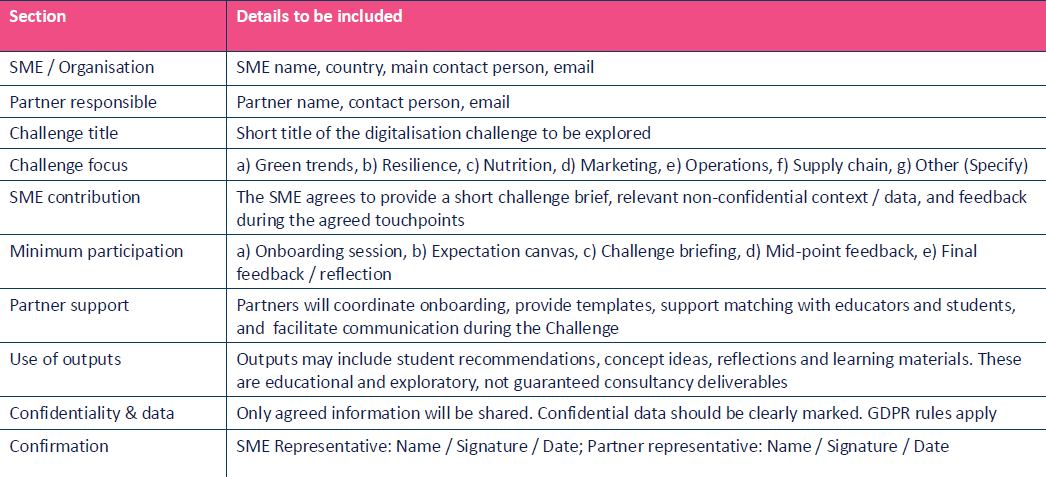
- Confirm participation through a light agreement
- Operates in the food and beverage sector
- Has concrete operational, marketing, sustainability, supply-chain, resilience, or nutritionrelated digitalisation challenge
- Can assign one contact person tha remains involved
- Can attend essential touchpoints or complete self-directed tasks
- Is willing to share enough information for students and educators to work meaningfully
- Understands that engaging in the SME Challenge after the bootcamp produces learningbased recommendations, not guaranteed consultancy outputs
RDDCA Bootcamp Learning Journey
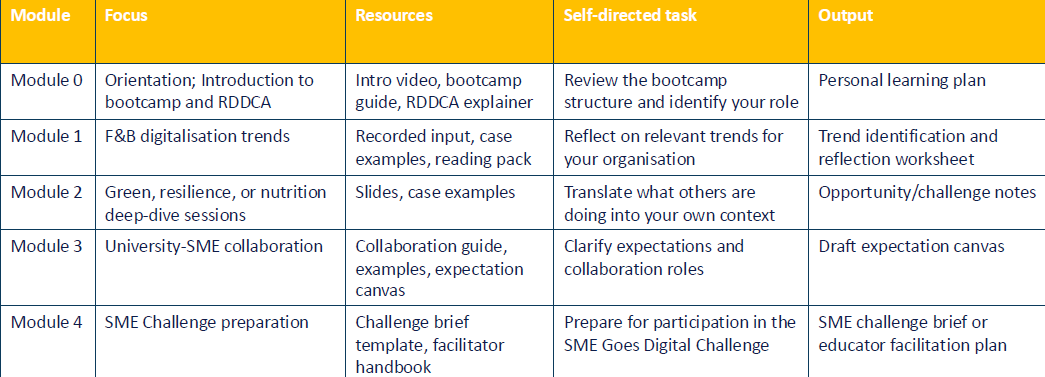

Learning Objectives and Outcomes
PURPOSE
- An overview of the bootcamp structure an objectives
- An introduction to the current F&B sector trends and market drivers
LEARNING OBJECTIVES
- Understanding the purpose and scope of the bootcamp
- Raising awareness and enable recognition of critical trends shaping the F&B sector
- Establishing a foundation of knowledge to build upon in the next sessions
LEARNING OUTCOMES
- Participants have clarity on the objectives of the bootcamp and the ways in which they can participate, as well as an overview of the main topics to be discussed as part of the bootcamp
- Participants have increased awareness of relevant market shifts and emerging trends in the food and beverage sector
- Participants understand these trends and are ready to think reflexively about them from their institutional contexts
DESCRIPTION
This session will showcase best practices (focusing on strategies, operational models or innovative approaches) on digitalisation of F&B
LEARNING OBJECTIVES
- Identifying key factors that contribute to the success of F&B digitalisation and what are the benefits associated to it
- Exploring real-world examples that can inspire participants to take action in their individual contexts
LEARNING OUTCOMES
- Participants can outline several methodologies and techniques, as well as the outcome of them, used by successfully digitalized F&B businesses
- Participants expand their horizon of ideas and get inspiration to apply them in their own organizational and/or teaching contexts
DESCRIPTION
This session will present the RDDCA concept, its relevance to the current F&B landscape and the potential that RDDCAs hold, specifically for SMEs who, due to their structural traits, might struggle to engage in digitalisation
LEARNING OBJECTIVES
- Defining what a RDDCA is, its characteristics and how the role can fit within the organisational organigram
- Understanding the importance of digital change leadership in today’s market
LEARNING OUTCOMES
- Participants can describe the core traits of a RDDCA and their potential impact in the F&B sector
- Participants can connect RDDCA principles to their own context, keeping in mind aspects such as sustainability and their own innovation goals
- Participants feel excited about and prepared to dive deeper into digital transformation aspects
DESCRIPTION
This session will examine environmental sustainability trends that are impacting the F&B sector (e.g., waste reduction, sustainable supply chain, resource management, etc.). Furthermore, there will be an interactive session on ‘Green trends’ that will engage participants in discussion around best practices and real-life implementation of green initiatives.
LEARNING OBJECTIVES
- Understanding how green trends influence consumer behaviour and impact operational processes
- Exploring success stories and potential challenges associated to implementing green initiatives in the sector
LEARNING OUTCOMES
- Participants are able to identify drivers and barriers to sustainable practices
- Participants gain insights into the business and environmental benefits of going green
- Participants are equipped to start working on / refining their own sustainability plans and actions
- Participants acquire hands-on experience in brainstorming green solutions or evaluating current practices
DESCRIPTION
This session will conduct one workshop with each of the targe groups, in parallel, to identify the main barriers hindering digitalisation of processes in the F&B sector. To achieve this, participants will be split into target-group specific breakout rooms for more targeted discussion.
LEARNING OBJECTIVES
- Identifying common and emerging digital transformation challenges
- Sharing individual experiences and brainstorming collaborative solutions
- Facilitating a discussion environment that fits each target group’s unique context
LEARNING OUTCOME
- Participants can list specific challenges and opportunities associated to digitalisation in F&B
- Educators walk out of the session with some ideas on integrating real-world challenges into curricula
- SMEs walk out of the session aware of practical approaches to overcoming digitalisation barriers
DESCRIPTION
This session will define ‘resilience’ in the participants’ context and will investigate strategies for building it within F&B operations and educational approaches. The session will cover, among other aspects of resilience, agility, the ability to manage risk properly and the importance of long-term adaptability. This session is followed by a practical discussion or set of activities (workshop / interactive format) on enhancing resilience and developing a forward-thinking mindset among the participants.
LEARNING OBJECTIVES
- Understanding the concept of organizational resilience and its importance in uncertain market environments
- Discovering tools, frameworks and best practices that can help increasing resilience
LEARNING OUTCOME
- Participants fully understand the concept of resilience and grasp what it means in their particular contexts
- Participants have starting points to integrate resilience measures into their business models or curricula
- Participants walk out of the session with a forward-thinking mindset for continuous improvement
- Participants walk out of the session with a better idea of how to adapt to disruptions in their operations
DESCRIPTION
This session will conduct one workshop with each of the targe groups, in parallel, to introduce the basics of university-business collaboration, and approaches to establishing and facilitating those interactions. Additionally, participants will work on preparing for the SME Goes Digital Challenge (i.e., educators will work with the facilitator handbook and SMEs will focus on developing their expectation canvas).
LEARNING OBJECTIVES
- Highlighting the mutual benefits of university-business collaboration
- Providing frameworks and guidelines for effective collaboration
- Showcasing good examples of university-SME collaboration
- Understanding each target group’s role in the SME Goes Digital Challenge and initiating the preparation work
LEARNING OUTCOME
- Participants understand the core principles for successful university-business collaboration
- Participants learn strategies and approaches to establish and maintain strong, mutually beneficial relationships
- Participants walk out of the session being ready to make the most out of their interactions as part of the SME Goes Digital Challenge and beyond
- Participants advance their preparatory work before the SME Goes Digital Challenge
DESCRIPTION
This session will present current trends on nutritional science and aspects of the F&B sector, as well as the impact of consumer expectations on those. The session will also cover the role of health, wellness and regulatory considerations. This session is followed by a practical discussion or set of activities (workshop / interactive format) on implementing nutrition insights into their operations.
LEARNING OBJECTIVES
- Understanding key nutritional concepts impacting product development, marketing and other aspects of the F&B sector operations
- Exploring innovative approaches through best practices
LEARNING OUTCOME
- Participants are able to link nutritional insights to their operations or to their curriculum planning
- Participants understand the reasoning behind nutritional customer trends and the market response to them
- Participants gain ideas for integrating nutritional best practices into their own projects
DESCRIPTION
This session will conduct one workshop with each of the targe groups, in parallel, to introduce the basics of university-business collaboration, and approaches to establishing and facilitating those interactions. Additionally, participants will work on preparing for the SME Goes Digital Challenge (i.e., educators will work with the facilitator handbook and SMEs will focus on developing their expectation canvas).
LEARNING OBJECTIVES
- Highlighting the mutual benefits of university-business collaboration
- Providing frameworks and guidelines for effective collaboration
- Showcasing good examples of university-SME collaboration
- Understanding each target group’s role in the SME Goes Digital Challenge and initiating the preparation work
LEARNING OUTCOME
- Participants understand the core principles for successful university-business collaboration
- Participants learn strategies and approaches to establish and maintain strong, mutually beneficial relationships
- Participants walk out of the session being ready to make the most out of their interactions as part of the SME Goes Digital Challenge and beyond
- Participants advance their preparatory work before the SME Goes Digital Challenge